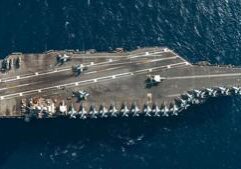
War in Iran shocks markets, costs U.S. taxpayers $1 billion a day
The escalating war in Iran has already rattled global markets and driven oil prices to their highest levels since April 2024. If the conflict persists, the strain on the global economy deepens and the burden on U.S. taxpayers grows.
With U.S. military operations costing more than a billion dollars each day, experts warn that a prolonged war could require a significant increase in defense spending, further affecting the federal budget.
The U.S. and Israel launched attacks on Iran on Feb. 28 after nuclear talks with Islamic Republic failed to produce a deal. President Donald Trump and Secretary of War Pete Hegseth have laid out four military objectives: Destroying Iran’s missile capabilities, neutralizing its navy, preventing the development of nuclear weapons, and ensuring the regime can’t direct terrorism beyond its borders.
Both Trump and Hegseth said the conflict is at the beginning. It’s unclear how long the war could continue, but Trump said it could be several weeks. On Friday, Trump said he would accept nothing less than Iran’s unconditional surrender.
U.S. gas prices surged to an average of $3.45 on Sunday, according to AAA, a $0.47 increase over the week. That’s the sharpest weekly rise since March 2022, when prices jumped $0.60 after Russia invaded Ukraine.
Since the Iran conflict began, oil prices have soared from around $65 to over $90 a barrel as of Friday.
Desmond Lachman, senior fellow at the American Enterprise Institute, said the economic hits could become more severe as the war continues.
He predicted gas prices could climb even higher, potentially exceeding $3.50 or even $3.75 per gallon.
“That has an impact on inflation and could also slow the economy. So it’s quite a big deal,” he said.
Shipping traffic through the critical Strait of Hormuz is nearly at a standstill, according to the Joint Maritime Information Center, an international group that tracks commercial shipping safety. The waterway usually handles about 20% of the world’s crude oil and natural gas shipments.
On average, about 138 vessels pass through the strait each day. That dropped to four earlier this week.
“This represents a near-total temporary pause in routine commercial traffic,” JMIC noted. “While no formal legal closure of the Strait has been universally acknowledged, the reduction stems from a combination of security threats, insurance constraints, operational uncertainty, and effective disruptions rather than a declared blockade.”
Lachman said the Strait of Hormuz is one problem, but Iran is also attacking oil and gas infrastructure, reducing supply.
“They are going after oil refineries and pipelines so there’ll be pressure on the United States to end the war,” he told The Center Square. “What’s happening right now is that those Gulf states are able to intercept the drones that the Iranians are sending, but the Iranians have got more drones than these states have got interceptors.”
Additional disruptions could send oil prices above $100 a barrel, Lachman said.
Goldman Sachs Research economists Jessica Rindels and Pierfrancesco Mei estimated that higher oil prices could hamper the U.S. economy and push up consumer prices. Higher oil prices reduce disposable income, which in turn limits spending, they noted.
“History suggests that oil price spikes driven by geopolitical shocks can be short-lived if markets gain confidence that supply disruptions will be temporary,” they wrote in a report.
How long the war with Iran will last and how far it might spread throughout the Middle East remain unclear, Lachman said.
“The trouble is, nobody really knows how long it will continue,” he told The Center Square.
United Nations Secretary-General António Guterres said Friday that the “situation could spiral beyond anyone’s control.”
“All the unlawful attacks in the Middle East and beyond are causing tremendous suffering and harm to civilians throughout the region – and pose a grave risk to the global economy, particularly to the most vulnerable people,” he said. “It is time to stop the fighting and get to serious diplomatic negotiations. The stakes could not be higher.”
In addition to the global economy, a long and costly war in Iran could hit U.S. taxpayers, Lachman said.
“This is costing over a billion dollars a day,” he told The Center Square. “So if this drags on, the U.S. is going to need a big increase in its defense budget, which can push interest rates up. You’ve just got to hope that this is a very short war; otherwise, there will be serious consequences.”
Trump is already looking to boost military spending. Trump previously proposed a $1.5 trillion budget for the Department of War, a 60% increase over existing levels.
On Friday, the nation’s largest defense contractors agreed to “quadruple Production of the ‘Exquisite Class’ Weaponry,” the president said in a social media post.
Event Calendar
[pdem_events format="calendar" size="xlarge" layout="stacked" exclude_category="sports,library" limit="22" debug="no"]
Latest News Stories

Lentz Excavating Recommended for Trail Rip Rap Project

Litchfield Upgrades Water Main Project on State Street Following Resident Concerns

Park District Secures $10,000 Grant for Concession Stand Project


- « Previous
- 1
- …
- 38
- 39
- 40