Return on investment questioned as Chicago Red Line construction begins
(The Center Square) – Taxpayers are facing a hefty price tag as construction begins on a long-anticipated Chicago Transit Authority project on Chicago’s Far South Side.
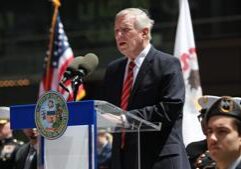
At a groundbreaking ceremony for the CTA Red Line extension Friday, Illinois U.S. Sen. Dick Durbin said he and then-Sen. Barack Obama put an earmark in a bill 18 years ago.
“We put in a request for, get ready, $285,000 for the Red Line extension. That was 18 years ago. The price tag’s gone up a little bit,” Durbin said.
The federal government is now kicking in nearly $2 billion of the total estimated cost of $5.75 billion to extend the rail line 5.5 miles south, adding four stops between the current end of the line at 95th Street and the new projected end at 130th St.
The U.S. Department of Transportation placed nearly $2 billion in federal funding for the project under review last October, but a federal judge directed the Trump administration to unfreeze the money last month.
Illinois Policy Institute policy researcher Ravi Mishra said the cost per mile is more than double the price of similar projects in other cities.
“The real issue points to transparency and planning. People deserve to know where the money is going and why the costs have gone up so much. Without that, it’s hard to say if you’re actually spending the money as efficiently as we could,” Mishra told The Center Square.
Mishra questioned the allocation of almost $1 billion in tax increment financing dollars for the project when Illinois has the highest property taxes in the country.
State Sen. Elgie Sims, D-Chicago, said the project would generate billions in economic activity.
“The state of Illinois already has made sure that we understand how vital this is, committing nearly half a billion dollars,” Sims said.
The Red Line extension has been discussed for decades. In January 2025, then-CTA president Dorval Carter said the project had an estimated cost of $144 million in the late 1960’s.
University of Chicago professor Justin Marlowe said some of the reason the price tag has increased so much is cost escalation due to inflation and higher interest rates on borrowed money.
“Another contributing factor is the way that the project has been planned and designed as the CTA has gone through the process of actually siting things and getting more into the details on the actual construction plans,” Marlowe told The Center Square.
Marlowe said, like with any larger project, there have been “unexpected twists and turns” around land acquisition, some of the cleanup that needed to happen and the add-on of transit-oriented development to help finance parts of the project.
Marlowe said, while the project remains popular, the potential return on investment seems to diminish every day.
“In a post-COVID world, the question of are people going to continue to live in the neighborhoods and commute into downtown is much more a question than it’s ever been,” Marlowe told The Center Square.
Marlowe said the whole point of the Red Line extension was to provide South Side neighborhoods with better access to commercial hubs in the Loop and other parts of the city.
Service on the Red Line extension is projected to begin in 2030.






Mostly Clear
Latest News Stories
Illinois quick hits: Pritzker reacts to HHS funding freeze; Chicago crime dashboard released
Convicted murderer can’t use IL juvy reform law to win chance at parole
Lt. Gov. Eleni Kounalakis pushes back on federal oil drilling
Flags flown at half-staff in Sacramento in LaMalfa’s honor

WATCH: IL Democrats take part in Jan. 6 hearing as Trump pushes voter ID
House Dems, Trump offer competing visions of Jan. 6

Illinois quick hits: Criminal justice grants announced; unemployment rate unchanged
State Rep: Illegal immigrants cost IL taxpayers more than enforcement
House committee to hold hearing Wednesday on Minnesota fraud
Court blocks Trump admin’s medical research funding cuts
Trump takes aim at defense contractors as he looks to speed arms production
WATCH: Candidate Dabrowski wants audit as IL Child Care Services funding skyrockets