
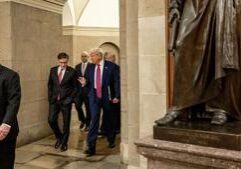
House Republican leaders back White House AI framework
House Republican leaders are pledging to enact the Trump administration’s newly released national legislative framework for AI regulation.
The proposal outlines how Congress should address AI threats to child safety, intellectual property rights, and free speech, as well as AI-driven rises in electricity costs and integrating AI into the workforce and national security sphere.
These nationally applicable issues “require strong Federal leadership to ensure the public’s trust in how AI is developed and used in their daily lives,” the administration said in its Friday announcement.
“Importantly, this framework can succeed only if it is applied uniformly across the United States. A patchwork of conflicting state laws would undermine American innovation and our ability to lead in the global AI race,” the White House added. “The Administration looks forward to working with Congress in the coming months to turn this framework into legislation that the President can sign.”
House Speaker Mike Johnson, R-La., House Majority Leader Steve Scalise, R-La., and other committee leaders praised the roadmap, stating that it “provides innovators with much-needed certainty, while protecting consumers and prioritizing kids’ online safety.”
“House Republicans look forward to working across the aisle to enact a national framework that unleashes the full potential of AI, cements the U.S. as the global leader, and provides important protections for American families,” the lawmakers said.
Any and all legislative implementation, the framework tells Congress, should respect states’ ability to impose their own AI regulations regarding child and consumer protection, fraud prevention, zoning laws for AI infrastructure, and state usage of AI.
At the same time, Congress should prevent state AI laws imposing “undue burdens” on AI development and ensure that state laws “do not govern areas better suited to the Federal Government or act contrary to the United States’ national strategy to achieve global AI dominance.”
“States should not be permitted to regulate AI development, because it is an inherently interstate phenomenon with key foreign policy and national security implications,” the framework emphasizes.
Specific proposals the White House wants to see adopted include establishing “commercially reasonable, privacy protective, age assurance requirements (such as parental attestation) for AI platforms and services likely to be accessed by minors,” though states can still make their own.
The administration also wants lawmakers to establish grants and tax incentives to support AI deployment among small businesses; expand AI-training workforce programs, especially for the youth; and streamline federal permitting for AI infrastructure while ensuring that residents don’t pick up the tab for increased electricity costs.
Communities with data centers often shoulder increased energy costs as electricity demand soars and utilities force American taxpayers to fund discounted rates for data centers, a recent study by Harvard Law School found.
Notably, the national AI framework calls for allowing Americans to sue the federal government if it censors free expression on AI platforms or dictates the information AI platforms can provide.
But it also suggests that Congress install protections for individuals against “unauthorized distribution or commercial use of AI-generated digital replicas of their voice, likeness, or other identifiable attributes, while providing clear exceptions for parody, satire, news reporting, and other expressive works protected by the First Amendment.”
The White House urged Congress to leave the issue of whether training AI models on copyrighted material is legal to the courts and refrain from establishing a new federal rulemaking body for AI.
From the beginning of his second term in office, President Donald Trump has focused on stimulating AI development and pushed for national cohesion on regulations.
Weeks after being sworn in, Trump reversed former President Joe Biden’s executive order that took a more cautious approach to AI development. He has touted and encouraged investments in AI startups. Republicans’ “One Big, Beautiful Bill” funneled billions of dollars to AI-related initiatives.
Trump also signed an executive order in December withholding broadband funds from states with AI regulations deemed to “harm innovation.”






Sunny
Latest News Stories
Trump admin throws cold water on ICE masks ban as shutdown talks stall
Supreme Court’s tariff ruling could alter 2026 election

Supreme Court reins in Trump on tariffs in split decision

Federal judge: Masked ICE agents violate Fourth Amendment

DOJ probes three Michigan schools over gender instruction, bathroom policies
Supreme Court strikes down bulk of Trump’s tariffs

Illinois Quick Hits: 15-year-old charged with machine gun possession

Summit Ridge Agrees to $25,000 Donation; Pattern Energy Updates Board
Newsom OKs $590M loan for Bay Area public transportation

Federal government issues guidance on prayer in schools

Illinois quick hits: Illinois Supreme Court sued over judge’s removal

CPA gives tips for avoiding red flags for NGOs getting taxpayer money