Supreme Court strikes down bulk of Trump’s tariffs
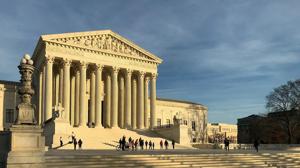
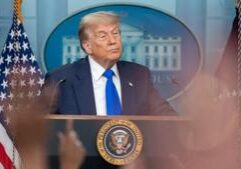
The U.S. Supreme Court on Friday said a 1977 law doesn’t give the president broad authority to issue tariffs, dealing a significant setback to President Donald Trump’s economic agenda.
Chief Justice John Roberts wrote in the majority opinion that “the Framers did not vest any part of the taxing power in the Executive Branch.”
Roberts said the tariffs violated the major questions doctrine. Trump’s interpretation of the 1977 International Emergency Economic Powers Act would be an “expansion of the President’s authority over tariff policy” that Congress didn’t intend.
“There is no exception to the major questions doctrine for emergency statutes,” the majority wrote. “Nor does the fact that tariffs implicate foreign affairs render he doctrine inapplicable. The Framers gave ‘Congress alone’ the power to impose tariffs during peacetime.”
Twelve states, five small businesses and two Illinois-based toymakers have challenged Trump’s authority to impose tariffs under the 1977 law without Congressional approval.That law, the International Emergency Economic Powers Act, does not mention the word “tariff” and, as the challengers stress, has never been used to impose tariffs.s.
The Supreme Court noted that in Friday’s decision.
“It is also telling that in IEEPA’s half century of existence, no President has invoked the statute to impose any tariffs, let alone tariffs of this magnitude and scope,” the high court wrote.
In November, Trump’s legal team had argued that the law is a clear delegation of emergency power, granting the president broad authority to act in times of crisis.
In August, the U.S. Court of Appeals for the Federal Circuit affirmed a lower court’s ruling that Trump did not have the authority, but said Trump’s tariffs could remain in place while the administration appeals to the U.S. Supreme Court. In the 7-4 decision, the Federal Circuit majority held that tariff authority rests with Congress.




Sunny
Latest News Stories
U.S. Supreme Court to hear anti-oil cases with energy costs on the line

Constitutional concerns raised over Illinois’ first civil hate crime case

Residents Voice Frustrations Over Oil and Chip Street Conditions

Newsom predicts smaller budget shortfall than state agency

Colorado ordered to pay $5.4M after abortion law blocked
Four Republicans certified for primary to take on Pritzker
Illinois quick hits: State sues over frozen funds; Nicor Gas seeks rate hike
Treasury, IRS ramp up investigation into Minnesota fraud

Tariff authority decision still awaited from Supreme Court

Minneapolis schools offer remote learning while ICE operations continue

Trump administration sued for freezing child care funds
Minnesota authorities cut out of ICE shooting investigation