
Supreme Court reins in Trump on tariffs in split decision
The Supreme Court ruled Friday that President Donald Trump exceeded his authority by imposing billions of dollars in worldwide tariffs.
The high court decision affects Trump’s tariffs enacted under the 1977 International Emergency Economic Powers Act. Trump had used the law to impose tariffs on nearly every imported product from every country.
Americans ended up paying billions of dollars in taxes on those imports, according to recent research.
The Supreme Court, divided 6-3, held that the law didn’t give Trump expansive tariff powers to tax goods entering the country.
Conservative Justices Amy Coney Barrett and Neil Gorsuch and the court’s liberal wing – Sonia Sotomayor, Elena Kagan and Ketanji Brown Jackson – joined Chief Justice John Roberts’ majority opinion.
Justices Clarence Thomas, Brett Kavanaugh and Samuel Alito dissented.
The majority ruled that Trump’s tariffs violated the major questions doctrine, which holds that Congress must speak clearly when it grants significant powers.
“The Framers gave ‘Congress alone’ the power to impose tariffs during peacetime,” Roberts wrote for the majority.
Alan Morrison, a constitutional law scholar at George Washington University Law School, said the ruling didn’t authorize refunds for U.S. businesses that paid billions to the federal government to import products since April 2025.
“Today’s decision did not order any refunds of the illegally collected tariffs because the plaintiffs only asked the Court to stop tariffs that had not yet been collected,” he said. “Litigation is underway to seek refunds of some of these tariffs, with other cases certain to follow.”
Gary Shapiro, executive chair and CEO of Consumer Technology Association, a trade group, said the decision could eliminate some uncertainty for businesses.
“The Court affirmed what our Founding Fathers were so careful to write into our Constitution: the power to tax Americans rests with Congress, not the president,” he said. “Innovation thrives on predictability, and this common-sense decision brings much-needed clarity for American businesses and consumers.”
He also called for the government to promptly refund the tariffs already paid and not issue new tariffs to replace the unlawful ones.
“The government must act quickly to refund retailers and importers without red tape or delay,” he said. “Our leaders should resist the urge to compound the error by turning to new tariff authorities that add more burden and uncertainty for America’s innovators, especially small businesses and startups.”
Before Friday’s ruling, Trump had repeatedly said an adverse ruling from the Supreme Court could trigger economic collapse.
The Penn Wharton Budget Model projected that reversing the tariffs would generate up to $175 billion in refunds. It further projected that future tariff revenue would fall by half unless replaced through another source.
The Committee for a Responsible Federal Budget said the high court decision could increase projected deficits by about $2 trillion over the next decade.
“The country will now be about $2 trillion deeper in the hole,” said Maya MacGuineas, president of the Committee for a Responsible Federal Budget. “With the national debt already the size of the entire U.S. economy and interest on the debt costing more than $1 trillion this year, this is very bad news.”
She called on Congress to “fill that hole” with new revenue and use all the money to reduce deficits.
Trump’s legal team had argued that the tariffs were regulatory, not designed to raise revenue, contradicting Trump’s public claims that the import duties would raise enough money to cover the cost of his spending priorities at home.
The White House did not immediately respond to questions about the Supreme Court decision. Trump has yet to comment publicly on the ruling, but plans to hold a news conference Friday afternoon.





Sunny
Latest News Stories

Siri class action lawsuit greenlit, billions at stake

California attorney general cites success in tackling fraud

Illinois Quick Hits: Reward offered in Chicago shooting
‘Ridiculous:’ Republicans reject Dems’ 10 demands for DHS reforms

Legal scholars clash over climate lawsuits against energy companies

Litchfield Firefighters Respond to Structure Fire
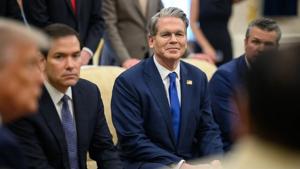
WATCH: Bessent spars with lawmakers over tariffs, Trump lawsuits

WATCH: Senate Dems: ‘We in Illinois need to tax’

Illinois senator seeks immediate expulsions for student sexual assault

Consortium Completes $620 Million Acquisition of Denny’s Corp.

Illinois Quick Hits: Ex-sheriff employee ordered to repay $35,000

Litchfield Campus Updates: Science Lab Complete, New Partnerships Formed