
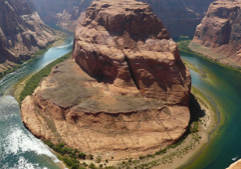
Deadline approaches for Colorado River negotiations
Officials negotiating to protect and redefine use of the Colorado River face a major deadline approaching on Feb. 14.
And experts said an agreement is unlikely to come in time for the river, which is a major source of drinking water, irrigation and hydropower in seven western states.
The deadline on a new Colorado River water use deal was set for last November, but got pushed back after an initial agreement was not reached. As the second deadline looms, the U.S. government has retained the right to impose a contract on the states.
“Water fundamentally underscores all aspects of life in the American Southwest,” said John Berggren, regional policy manager at Western Resource Advocates, an environmental policy group.
“It’s such a diverse and complicated system that it’s a challenge to manage or create new guidelines,” Berggren told The Center Square.
The Colorado River provides drinking water for roughly 40 million people across seven states, over 30 Indigenous tribes and Mexico. The river has been consistently depleted for the last quarter of a century amid droughts and overuse by people, largely for agriculture. River usage has been negotiated for decades, with the current 2007 agreement set to expire this year.
Governors from six Colorado River Basin states (Arizona, Colorado, Nevada, New Mexico, Utah and Wyoming) and a high-level California representative met late January in Washington, D.C., for an unprecedented crunch-time negotiation. The meeting with the U.S. Department of Interior took place behind closed doors, but no agreement was made, with no indication that the Feb. 14 deadline will be met.
Several governors expressed cautious optimism after the meeting. “Today’s discussion was productive and reflected the seriousness this moment requires,” Colorado Gov. Jared Polis said in a news release.
“I leave today hopeful that we’ll avoid the path of litigation,” said Utah Gov. Spencer Cox. “No one wins going down that path.”
But litigation could soon be on the table. Current negotiations have been ongoing for the last two and a half years, with state leaders agreeing if negotiations went to court it would be a failure.
“We’re hearing about states building up their litigation funds, and that’s really concerning because that means that they’re not close to a deal, which is catastrophic for the basin,” said Berggren. “It puts us into a whole bunch of uncertainty and most likely means one or more states are going to sue. That will drive the system, which is already in a pretty dire situation, just off the cliff.”
Hang-ups around the negotiations start with the original 1922 Colorado River Compact, or “Law of the River,” which allocated 15 million acre-feet of water to be drawn per year, despite there never being that much water in the river. Today, there is even less, between 12 and 11 million acre-feet.
While Mexico was later allocated a relatively small portion of the river rights, Indigenous tribes have historically been, and continue to be, left out of the negotiations. Tribal inclusion in the negotiations has slightly increased in recent years.
But “it’s nowhere near what it needs to be,” said Berggren. “These are sovereign nations that have water rights claims or water rights settlements that the United States has a responsibility to uphold, and they’re not at the decision-making table. That’s a huge wrong and it needs to be righted.”
Many Colorado River experts agree a large part of the overall Colorado River negotiation issue is how outdated some of the laws and regulations are today. The original water usage regulations came out of 1800s’ first-come, first-served rights mining laws. The dams and other river infrastructure were built in the 1900s, but continue to be used by a population facing today’s issues including climate change.
“What that all means is we’re having to find creative ways to use less water everywhere,” Berggren told The Center Square.
At the moment, each state argues it has sacrificed more than its fair share. Much of the debate between states falls along an upper-lower basin boundary.
Upper Basin Colorado River states are required to allow a certain amount of water to flow to Lower Basin states each year, but the two groups do not agree how much that is. Meanwhile, Lower Basin states like Nevada, California and Arizona have grown drastically over recent decades and consumed far more water than Upper-Basin states.
“The solution is everyone needs to use less water,” said Berggren. “And so people just need to accept that. Let’s start being constructive with how we are going to find ways to use less water across the basin.”
Despite the gravity of the situation, experts have said there is reason for optimism by improved water efficiency. Perhaps the best example of this is Las Vegas, which has become the poster child of Colorado River water conservation in recent years.
Las Vegas’ population increased by roughly 829,000 residents between 2002 and 2024, but the city used 38 billion less gallons in 2024 – a 55% per capita decline in water usage, according to the Las Vegas Valley Water District. Much of this has been attributed to water recycling initiatives and regulations around watering lawns and other spaces. Further water usage cuts for the area are set for 2027 that include irrigation bans for unused medians and roundabouts with Colorado River water.
“We have solutions, and we just need to implement them,” said Berggren. “We can have a thriving river in the American Southwest with the recreational, agricultural and all the other economies also thriving – if we’re smarter about the way we manage our limited water supplies.”
The federal government has not yet indicated if it will delay the deadline again or begin to exercise its authority on the Colorado River. Berggren said he thought the Trump administration would take action if the states miss the Feb. 14 deadline. “That’s incredibly unfortunate, and that just shows that the feds will just have to move forward the best they can.”
Berggren predicted the dispute over water will end up before the nation’s highest court.
“Because it’s an interstate compact, it’ll go before the Supreme Court,” said Berggren. “And so instead of communities here in the Colorado River Basin deciding how we’re going to use less water, it’s going to be the Supreme Court justices saying who’s going to be the winner and loser. And I don’t know anyone who feels confident that they will be a winner in that situation, because there’s a risk for everyone to be a loser.”
The Colorado River is a waterway with countless ecosystems and species that rely on its flow. At the delta of the river in Mexico, the river has dried up from decades of overuse, where Berggren said he has stood in the dried up river bed.
“I think rivers are the coolest thing I’ve ever experienced,” Berggren said. “There’s nothing like doing a multi-day rafting trip on a river like the Colorado River – it’s life changing. You really get to experience that this is a living, breathing thing.”






Sunny
Latest News Stories

U.S. rep.: Mexico still not delivering water to South Texas, despite claims

Supporters say will storage option would streamline judicial process

Dallas Fed: Geopolitical conflicts creating uncertainty for U.S. oil and gas industry

Illinois Quick Hits: Pritzker pushes for E15

Montgomery County Board Approves $858,000 in Ambulance Service Contracts

Trump addresses nation on Iran strikes; signals conflict nearing end

IL biometrics privacy reforms apply to past cases, too: Appeals court

Artemis II heads to the moon with first crewed mission since 1972

Pro-life org to Trump: Taxpayers should not be forced to fund killing of unborn children
Birthright citizenship advocates confident in SCOTUS hearing

College funding bill draws dissent from big Illinois universities

Illinois quick hits: Chicago announces $300 million housing spend; Rockford men faces cocaine trafficking charges; State to honor troopers killed in the ling of duty